

- Instructor: Mohd Shahnawaz Siddiqui
- Lectures: 40
- Quizzes: 33
- Students: 1
- Duration: 10 weeks

Introduction:
Welcome to the Professional Diploma in Digital Marketing & E-commerce Operations. In today’s hyper-connected world, the boundary between “shopping” and “living” has disappeared. For businesses to survive and thrive, they require professionals who understand not just how to attract a customer, but how to manage the complex digital machinery that fulfills a promise from the first click to the final delivery.
This diploma is a comprehensive journey through the dual engines of modern retail: Digital Marketing (the art of visibility and persuasion) and E-commerce Operations (the science of conversion, logistics, and scalability).
The Core Philosophy: “The Integrated Loop”
Most programs teach marketing and operations as separate silos. This course is built on the belief that they are inseparable.
-
Marketing brings the guest to the party.
-
Operations ensures the party is worth staying for.
Throughout these 8 modules, you will learn to bridge the gap between creative storytelling and technical execution.
This analogy is the heartbeat of the course. It explains the relationship between front-end attraction and back-end execution. When we look at e-commerce, a “great party” only works if both the invitation and the experience are perfect.
Here is a breakdown of what “The Integrated Loop” actually means in a business context:
-
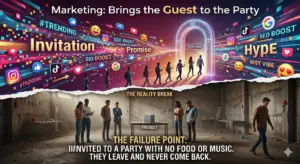
Marketing: “Brings the Guest to the Party”
Marketing is everything the customer sees before they commit to a purchase. It is the “invitation.”
-
The Look & Feel: Your social media ads, your Google ranking, and your brand’s “vibe.”
-
The Promise: You are telling the customer, “We have the solution to your problem,” or “This product will make your life better.”
-
The Hype: Creating enough excitement (clicks and traffic) to get people to walk through your digital front door (your website).
-
The Failure Point: If your marketing is great but your product is bad, you’ve invited people to a party with no food or music. They will leave immediately and never come back.
-
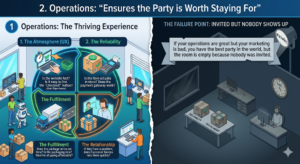
Operations: “Ensures the Party is Worth Staying For”
Operations is everything that happens once the customer arrives and after they click “Buy.” It is the “experience.”
-
The Atmosphere: Is the website fast? Is it easy to find the “Checkout” button? (User Experience).
-
The Reliability: Is the item actually in stock? Does the payment gateway work?
-
The Fulfillment: Does the package arrive on time? Is the packaging nice? Was the shipping affordable?
-
The Relationship: If they have a problem, does Customer Service help them quickly?
-
The Failure Point: If your operations are great but your marketing is bad, you have the best party in the world, but the room is empty because nobody was invited.
-
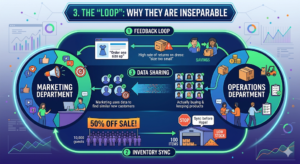
The “Loop”: Why They Are Inseparable
In “The Integrated Loop,” these two departments talk to each other constantly:
-
Feedback Loop: If Operations notices a high rate of returns on a specific dress because the “size is too small,” they tell Marketing. Marketing then updates the website to say, “Order one size up,” which saves the company money and keeps customers happy.
-
Inventory Sync: Marketing shouldn’t run a massive 50% off sale (bringing 10,000 guests) if Operations only has 100 items in the warehouse.
-
Data Sharing: Operations sees who is actually buying and keeping products. Marketing uses that data to find more people just like them.
Summary Table
|
Feature |
Marketing (The Invitation) |
Operations (The Experience) |
|
Goal |
Visibility & Traffic |
Conversion & Retention |
|
Focus |
Emotions and Clicks |
Logic and Logistics |
|
Metric |
Cost Per Click (CPC) |
Order Fulfillment Time |
|
Result |
A First-Time Customer |
A Loyal Fan |
What You Will Explore
This program is structured to transform you from a digital user into a digital architect. You will explore:
-
Strategic Growth: How to identify market gaps and build a brand identity that resonates.
-
The Technical Stack: Navigating the software and platforms that power the world’s biggest online stores.
-
The Traffic Engine: Mastering SEO, Paid Search, and Social Media to drive high-intent visitors.
-
Customer Retention: Using automation and psychology to turn one-time buyers into lifelong advocates.
-
Operational Resilience: Managing the “unseen” world of inventory, supply chains, and global shipping.
Course Objectives
By the end of this professional diploma, you will be able to:
-
Architect a full-scale e-commerce storefront optimized for maximum conversion.
-
Execute multi-channel marketing campaigns that deliver a measurable Return on Investment (ROI).
-
Analyze complex data sets to identify friction points in the customer journey.
-
Optimize backend operations to reduce costs and improve customer satisfaction.
-
Lead digital transformation projects within existing organizations or launch your own venture.
The digital marketplace is no longer just an “alternative” to physical retail—it is the primary engine of global commerce. This Professional Diploma is an intensive, career-aligned program designed to bridge the gap between creative marketing and technical operations.
In a world where launching a website is easy but building a profitable, scalable brand is difficult, this course provides the strategic blueprint. It moves beyond simple social media posts, diving deep into the logistics, data analytics, and conversion psychology that define successful online businesses.
Why Join This Course? Key Benefits
By enrolling in this program, you gain a comprehensive toolkit that prepares you for the complexities of the modern digital economy.
-
Master the Full “End-to-End” Ecosystem
Most courses focus only on “Marketing” (getting clicks) or “Operations” (shipping boxes). This diploma connects the two. You will understand how a marketing campaign affects inventory levels and how user experience (UX) directly impacts your return on ad spend (ROAS).
-
Data-Driven Decision Making
You will move away from “gut feelings” and learn to speak the language of data. By mastering tools like GA4 and Attribution Modeling, you will be able to prove exactly which marketing dollars are generating profit and where your website is losing customers.
-
Operational Excellence
A great marketing campaign can fail if the operations aren’t ready. This course teaches you the “invisible” side of e-commerce: supply chain management, 3PL (Third-Party Logistics), and automated customer service, ensuring that your business can scale without breaking.
-
Future-Proof Career Skills
The curriculum is built around the latest industry shifts, including:
-
AI Integration: Using artificial intelligence for personalization and efficiency.
-
Social Commerce: Leveraging TikTok and Instagram as direct sales channels.
-
Privacy Compliance: Navigating the complex world of data protection and consumer rights.
-
Strategic Leadership Perspective
Beyond technical skills, this diploma prepares you for leadership. You will learn how to design a Customer Lifetime Value (LTV) strategy that ensures long-term business health rather than just short-term sales spikes.
Who is this for?
-
Aspiring Entrepreneurs looking to launch and scale their own online brands.
-
Marketing Professionals wanting to transition into the high-growth e-commerce sector.
-
Retail Managers tasked with moving traditional brick-and-mortar operations into the digital space.
-
Career Switchers seeking a structured, comprehensive entry point into the tech industry.
Outcome: Upon completion, you won’t just know how to “run ads”—you will know how to architect, manage, and grow a multi-channel digital enterprise.
Curriculum
- 9 Sections
- 40 Lessons
- 10 Weeks
- Module 1: Foundations of Digital Commerce9
- 1.1Lesson 1:1 The Evolution of E-commerce: B2B, B2C, and C2C Models.6 Hours
- 1.2Lesson 1 :190 Minutes5 Questions
- 1.3Lesson 1.2: Consumer Psychology & The Digital Decision Journey.6 Hours
- 1.4Lesson 1.2:90 Minutes5 Questions
- 1.5Lesson 1.3: Market Research & Competitive Intelligence Tools.6 Hours
- 1.6Lesson 1.3:90 Minutes5 Questions
- 1.7Lesson 1.4: Legal Essentials: GDPR, Data Privacy, and Consumer Rights.6 Hours
- 1.8Lesson 1.4:90 Minutes5 Questions
- 1.9Module 1 : pdf File24 Hours
- Module 2: Building the High-Conversion Storefront9
- 2.1Lesson 2.1: Choosing the Right Platform (Shopify, Magento, WooCommerce).6 Hours
- 2.2Lesson 2.1:90 Minutes5 Questions
- 2.3Lesson 2.2: Principles of UX/UI for E-commerce Conversion.6 Hours
- 2.4Lesson 2.2:90 Minutes5 Questions
- 2.5Lesson 2.3: Product Information Management (PIM) & Catalog Structure.6 Hours
- 2.6Lesson 2.3:90 Minutes5 Questions
- 2.7Lesson 2.4: Mobile Commerce: Optimizing for the M-Commerce Wave.6 Hours
- 2.8Lesson 2.4:90 Minutes5 Questions
- 2.9Module 2 : pdf File24 Hours
- Module 3: Search Engine Ecosystems (SEO & SEM)9
- 3.1Lesson 3.1: Technical & On-Page SEO for E-commerce Product Pages.6 Hours
- 3.2Lesson 3.1:90 Minutes5 Questions
- 3.3Lesson 3.2: Keyword Strategy and Intent Mapping.6 Hours
- 3.4Lesson 3.2:90 Minutes5 Questions
- 3.5Lesson 3.3: Google Ads & Search Engine Marketing (SEM) Fundamentals.6 Hours
- 3.6Lesson 3.3:90 Minutes5 Questions
- 3.7Lesson 3.4: Google Shopping & Performance Max Campaigns.6 Hours
- 3.8Lesson 3.4:90 Minutes5 Questions
- 3.9Module 3 : pdf File24 Hours
- Module 4: Social Commerce & Content Strategy9
- 4.1Lesson 4.1: Social Media Algorithms & Organic Brand Building.6 Hours
- 4.2Lesson 4.1:90 Minutes5 Questions
- 4.3Lesson 4.2: Paid Social: Meta, TikTok, and Pinterest Ads.6 Hours
- 4.4Lesson 4.2:90 Minutes5 Questions
- 4.5Lesson 4.3: Influencer Marketing & Affiliate Partnerships.6 Hours
- 4.6Lesson 4.3:90 Minutes5 Questions
- 4.7Lesson 4.4: Content Marketing: Video, Blogs, and User-Generated Content.6 Hours
- 4.8Lesson 4.4:90 Minutes5 Questions
- 4.9Module 4 : pdf File24 Hours
- Module 5: Email Marketing & Customer Retention9
- 5.1Lesson 5.1: Building and Segmenting a High-Value Email List.6 Hours
- 5.2Lesson 5.1:90 Minutes5 Questions
- 5.3Lesson 5.2: Marketing Automation: Abandoned Carts & Welcome Flows.6 Hours
- 5.4Lesson 5.2:90 Minutes5 Questions
- 5.5Lesson 5.3: Loyalty Programs & Subscription Models.6 Hours
- 5.6Lesson 5.3:90 Minutes5 Questions
- 5.7Lesson 5.4: SMS Marketing and Push Notifications.6 Hours
- 5.8Lesson 5.4:90 Minutes5 Questions
- 5.9Module 5: pdf File24 Hours
- Module 6: E-commerce Operations & Logistics9
- 6.1Lesson 6.1: Inventory Management & Demand Forecasting.6 Hours
- 6.2Lesson 6.1:90 Minutes5 Questions
- 6.3Lesson 6.2: Fulfillment Strategies: In-house vs. 3PL vs. Dropshipping.6 Hours
- 6.4Lesson 6.2:90 Minutes5 Questions
- 6.5Lesson 6.3: Reverse Logistics: Managing Returns and Exchanges.6 Hours
- 6.6Lesson 6.3:90 Minutes5 Questions
- 6.7Lesson 6.4: Customer Service Excellence & Helpdesk Integration.6 Hours
- 6.8Lesson 6.4:90 Minutes5 Questions
- 6.9Module 6: pdf File24 Hours
- Module 7: Data Analytics & Performance Optimization9
- 7.1Lesson 7.1: Setting up Google Analytics 4 (GA4) for E-commerce.6 Hours
- 7.2Lesson 7.1:90 Minutes5 Questions
- 7.3Lesson 7.2: Key Performance Indicators (KPIs): CAC, LTV, and ROAS.6 Hours
- 7.4Lesson 7.2:90 Minutes5 Questions
- 7.5Lesson 7.3: A/B Testing & Conversion Rate Optimization (CRO).6 Hours
- 7.6Lesson 7.3:90 Minutes5 Questions
- 7.7Lesson 7.4: Attribution Modeling: Understanding the Path to Purchase.6 Hours
- 7.8Lesson 7.4:90 Minutes5 Questions
- 7.9Module 7: pdf File24 Hours
- Module 8: Scaling & The Future of Digital Retail9
- 8.1Lesson 8.1: Internationalization: Multi-currency and Localization.6 Hours
- 8.2Lesson 8.1:90 Minutes5 Questions
- 8.3Lesson 8.2: Marketplace Expansion: Amazon, eBay, and Walmart.6 Hours
- 8.4Lesson 8.2:90 Minutes5 Questions
- 8.5Lesson 8.3: AI in E-commerce: Chatbots, Personalization, and Product Recs.6 Hours
- 8.6Lesson 8.3:90 Minutes5 Questions
- 8.7Lesson 8.4: Emerging Trends: Live Shopping and the Metaverse.6 Hours
- 8.8Lesson 8.4:90 Minutes5 Questions
- 8.9Module 8: pdf File24 Hours
- Final Exam (40 Questions)1

Related Courses

Diploma in Child Care and Education of Young Children – 6 months
Prompt Engineering for Teachers (2h)

Safeguarding (5h)
Reggio Emilia (2h)

Leave feedback about this