- Instructor: Mohd Shahnawaz Siddiqui
- Lectures: 12
- Quizzes: 13
- Duration: 10 weeks
Introduction:
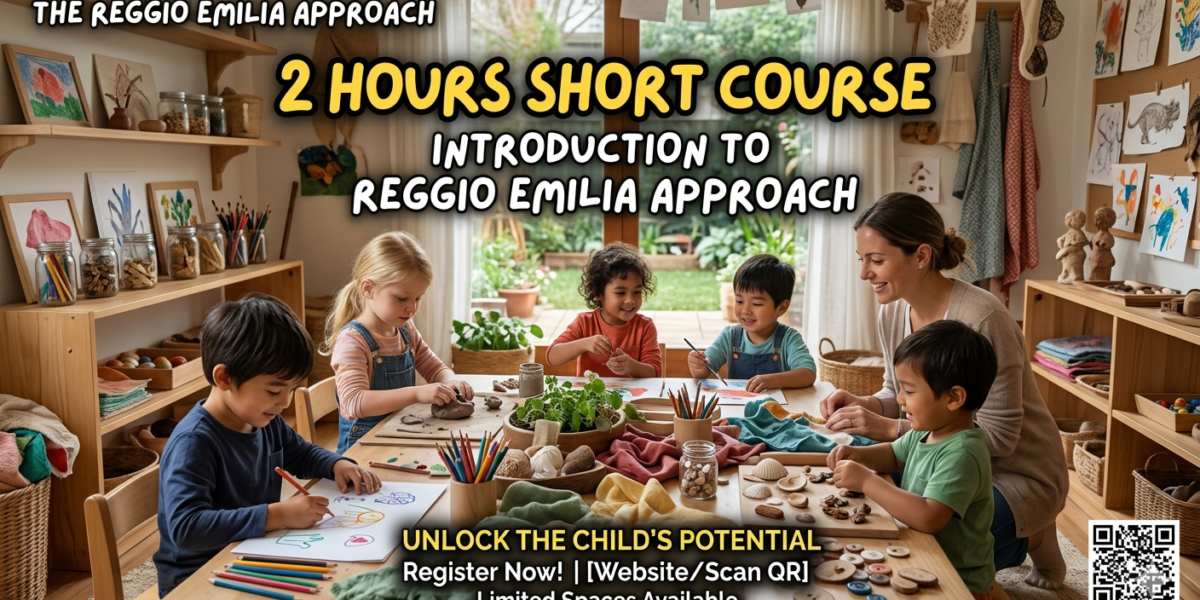
Welcome to this specialized course on the Reggio Emilia Approach. Originating in post-WWII Italy, this educational philosophy has become a global gold standard for early childhood pedagogy. It is built on the belief that children are “rich in potential,” driven by their own curiosity, and possess “a hundred languages” through which they express their ideas.
This course is designed for educators, school leaders, and curriculum developers who want to move away from rigid, top-down teaching methods toward a more organic, child-led environment. You will learn how to transform your classroom into a “third teacher” and document student journeys in a way that meets high regulatory standards.
Why Join This Course? (Key Benefits)
By participating in this program, you will gain the tools to revolutionize your teaching practice and institutional management:
- Mastering the “Third Teacher” Concept
Environment is a core pillar of this philosophy. You will learn:
- How to design classroom spaces that provoke inquiry and discovery.
- The use of natural light, mirrors, and “ateliers” (art studios) to stimulate sensory learning.
- Ways to organize materials that encourage independence in children from birth to age eight.
- Developing Emergent Curriculum
Instead of following a fixed, pre-printed book, you will learn to:
- Observe and listen to children to identify their interests.
- Build a “Project-Based” curriculum that evolves in real-time based on student questions.
- Integrate core developmental domains (literacy, numeracy, social skills) seamlessly into play.
- Professional Documentation Skills
Documentation is the “heart” of Reggio Emilia. This course teaches you to:
- Use photos, transcriptions of children’s words, and work samples to make learning visible.
- Present documentation as a tool for assessment that satisfies inspectors and regulatory bodies (like KHDA or ADEK).
- Create a narrative of a child’s growth that replaces standard, dry progress reports.
- Inclusive & Neurodiverse Frameworks
The Reggio approach is naturally inclusive. You will discover how:
- The “Hundred Languages” (drawing, sculpting, dancing, etc.) allows children with different learning needs to excel.
- To foster an Inclusive Leadership Mindset where every child’s unique perspective is seen as a contribution to the group.
- Stronger Community & Parent Partnerships
Learn to view parents as “active participants” rather than just customers. This course provides strategies for:
- Engaging families in the educational project of the school.
- Building a collaborative culture between teachers, parents, and administrators to support school development plans.
Curriculum
- 7 Sections
- 12 Lessons
- 10 Weeks
- Module 1: Foundations & The Image of the Child4
- Module 2: The Environment as the Third Teacher4
- Module 3: The Emergent Curriculum & Project Work4
- Module 4: Making Learning Visible: Documentation4
- Module 5: The Role of the Teacher & Pedagogical Coordination4
- Module 6: Community, Parents, and Cultural Context4
- Final Exam (30 Questions)1

Related Courses
Diploma in Child Care and Education of Young Children – 6 months
Prompt Engineering for Teachers (2h)

Safeguarding (5h)

Professional Diploma in Digital Marketing & E-commerce Operations

Leave feedback about this