
Lesson 1.1: Crafting Vision and Mission Statements that Drive Culture
The Theoretical Core
Most schools have a “Vision Statement” gathering dust in a handbook. Strategic leadership turns these words into Institutional DNA.
- The Vision: The “Where.” It must be aspirational. (e.g., “To graduate the global leaders of the 22nd century.”)
- The Mission: The “How.” It is the operational promise. (e.g., “Through rigorous inquiry-based learning and inclusive community values.”)
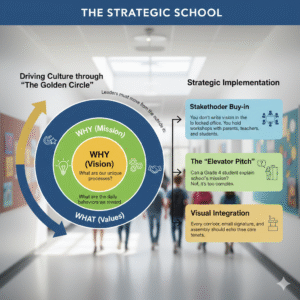
Driving Culture through “The Golden Circle”
Leaders must move from the outside in:
- Why (Vision): Why does this school exist?
- How (Mission): What are our unique processes?
- What (Values): What are the daily behaviors we reward?
Strategic Implementation
- Stakeholder Buy-in: You don’t write a vision in a locked office. You hold workshops with parents, teachers, and students.
- The “Elevator Pitch”: Can a Grade 4 student explain the school’s mission? If not, it’s too complex.
- Visual Integration: Every corridor, email signature, and assembly should echo these core tenets.
This guide transforms static words into a living, breathing institutional identity. To lead a school effectively, the Vision and Mission must act as the “North Star” for every decision, from hiring to curriculum design.
- The Theoretical Core: Vision vs. Mission
Understanding the distinction between these two is the first step in strategic leadership.
The Vision (The “Where”)
The Vision is your aspirational destination. It is a portrait of the future that the school intends to create. It should be bold, timeless, and slightly beyond reach to keep the institution striving.
- Key Question: What does the world look like because our school exists?
- Example: “To be the global benchmark for creative excellence in education.”
The Mission (The “How”)
The Mission is the operational promise. It describes the school’s daily purpose and the specific path it takes to reach the vision. It is grounded in the present.
- Key Question: What do we do every day to make our vision a reality?
- Example: “By fostering a technology-rich environment and a culture of collaborative problem-solving.”
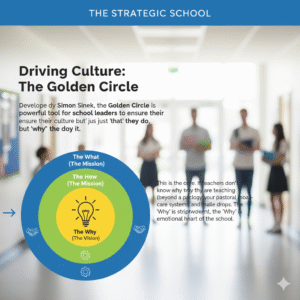
- Driving Culture: The Golden Circle
Developed by Simon Sinek, the Golden Circle is a powerful tool for school leaders to ensure their culture isn’t just about “what” they do, but “why” they do it.
- The Why (The Vision): This is the core. If teachers don’t know why they are teaching (beyond a paycheck), morale drops. The “Why” is the emotional heart of the school.
- The How (The Mission): These are the unique processes—your specific pedagogy, your pastoral care systems, and your extracurricular philosophy.
- The What (The Values): These are the tangible results and daily behaviors. If your “Why” is Empowerment, but your “What” is strict, rigid micro-management, the culture will fail.
- Strategic Implementation: From Paper to Practice
A vision statement is useless if it only exists on a website. It must be integrated into the school’s DNA.
- Stakeholder Buy-in
Leadership should not be a “top-down” vacuum. To drive culture, you must involve:
- Faculty Workshops: Let teachers define the “values” they want to live by.
- Student Voice: Ask students what makes their school special.
- Parent Focus Groups: Understand what the community expects from the institution.
- The “Elevator Pitch” Test
Complexity is the enemy of culture. If a 10-year-old student cannot explain the school’s mission in one simple sentence, it is too academic and will be ignored.
- Goal: Simplicity and Memorability.
- Visual and Ritual Integration
- Corridors: Use environmental graphics to showcase values.
- Email Signatures: Include the mission statement in every communication.
- Assemblies: Every success story shared in assembly should be explicitly linked back to a core value (e.g., “Sarah showed Resilience today when she…”).
- The Culture Flow Diagram
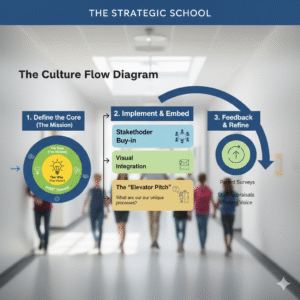
This illustrates how abstract ideas become concrete school culture.
- Case Study: The “Leadership Academy”
|
Element |
Description |
|
Vision |
To graduate the ethical leaders of the 22nd century. |
|
Mission |
Providing a dual-language, project-based curriculum that prizes character as much as grades. |
|
Value in Action |
Instead of just “Math Class,” students work on a “Community Budget Project” (Leadership + Academics). |
- Audit Checklist for Leaders
To ensure your Vision and Mission are driving culture, ask yourself these 5 questions:
- Consistency: Is the mission cited during staff disciplinary or appraisal meetings?
- Recruitment: Do we interview candidates based on our core values?
- Budgeting: Does our CapEx (Module 2) reflect our Vision? (e.g., If the vision is “Innovation,” are we investing in tech?)
- Environment: If a stranger walked into the lobby, could they guess our mission within 60 seconds?
- Language: Does the staff use a “common language” derived from the mission statement?