

Lesson 1.1: Introduction to Artificial Intelligence (Week 1)
Learning Objectives:
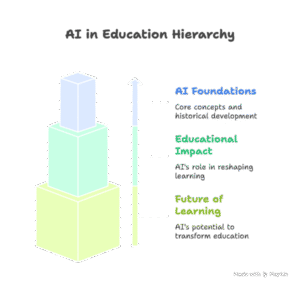
- Define Artificial Intelligence (AI) and differentiate between Weak AI and Strong AI.
- Explain the concepts of Machine Learning, Deep Learning, and Generative AI.
- Trace the brief history and evolution of AI.
- Identify core AI concepts: algorithms, data, and models.
- Recognize common AI applications in everyday life.
Content:
 What is Artificial Intelligence?
- Definition: AI is the simulation of human intelligence processes by machines, especially computer systems. These processes include learning, reasoning, problem-solving, perception, and language understanding.
- Weak AI (Narrow AI): AI designed and trained for a specific task. Highly capable within its defined scope but cannot perform outside of it.
- Examples: Virtual assistants (Siri, Alexa), spam filters, chess-playing programs, recommendation engines.
- Self-Reflection Question: “Think about a task you perform daily that could be considered ‘narrow’ and how AI might help with it.”
- Strong AI (General AI): A hypothetical type of AI that would possess human-like cognitive abilities, including self-awareness, consciousness, and the ability to apply intelligence to any problem.
- Discussion Prompt: “Why is Strong AI considered hypothetical and what ethical challenges might it pose if achieved?”
- Illustrations (Conceptual, for a rich learning experience):
- [Image/Graphic: A simple infographic showing a brain icon connected to a computer chip icon with “AI” overlay. Another graphic contrasting “Weak AI” with specific examples (robot vacuum, smartphone) and “Strong AI” with a more generalized, sentient-looking robot icon.]
- [Video: A short introductory video (2-3 minutes) explaining the basic concept of AI and its two main categories with simple analogies.]
- Branches of AI: Machine Learning, Deep Learning, Generative AI
- Machine Learning (ML): A subset of AI that allows systems to learn from data without being explicitly programmed. ML algorithms learn patterns from large datasets and use these patterns to make predictions or decisions.
- Key Techniques: Supervised Learning (labeled data), Unsupervised Learning (unlabeled data), Reinforcement Learning (learning through rewards/penalties).
- Activity: “Provide an example dataset (e.g., student grades vs. study hours) and discuss how an ML algorithm could learn from it.”
- Deep Learning (DL): A subset of Machine Learning that uses artificial neural networks with many layers (“deep” layers) to analyze data. Inspired by the human brain, deep learning excels in tasks like image recognition, speech recognition, and natural language processing.
- Relevance: Powers many advanced AI applications we see today.
- Generative AI: A type of AI that can create new content (text, images, audio, video) that is original but statistically similar to the data it was trained on.
- Examples: Large Language Models (LLMs) like ChatGPT, image generators (Midjourney, DALL-E).
- Discussion Prompt: “How do you think Generative AI differs from traditional AI applications like a search engine?”
- Illustrations (Conceptual):
- [Graphic: A Venn diagram showing AI as the largest circle, ML as a smaller circle inside AI, and DL as an even smaller circle inside ML. Another graphic illustrating the concept of a neural network with input, hidden, and output layers.]
- [Video: A short animation explaining the difference between ML, DL, and Generative AI with simple visual metaphors (e.g., ML learning to sort fruits, DL identifying specific fruit types, Generative AI creating a new fruit).]
2. A Brief History of AI’s Evolution:
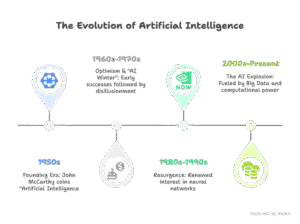
- 1950s – Founding Era: John McCarthy coins “Artificial Intelligence” (1956). Alan Turing proposes the Turing Test (1950). Early symbolic AI and expert systems.
- 1960s-1970s – Optimism & “AI Winter”: Early successes lead to high expectations, followed by a period of reduced funding and disillusionment when ambitious goals proved difficult. Limited computing power was a major constraint.
- 1980s-1990s – Resurgence: Renewed interest in neural networks and genetic algorithms. Development of more powerful computers.
- 2000s-Present – The AI Explosion: Fueled by:
- Big Data: Vast amounts of digital data available for training.
- Computational Power: Powerful GPUs (Graphics Processing Units) capable of handling complex calculations for deep learning.
- Algorithmic Advancements: Breakthroughs in deep learning architectures and techniques.
- Illustrations (Conceptual): A horizontal timeline showing key milestones: Dartmouth workshop, AI Winters, Deep Blue beats Kasparov, ImageNet breakthrough, AlphaGo, rise of LLMs.*
- Discussion: “How did the availability of ‘Big Data’ change the trajectory of AI development?”
3. Core Concepts in AI:
- Algorithms: A set of well-defined rules or instructions that a computer follows to perform a task. In AI, these algorithms are designed to learn from data.
- Analogy: “Think of an algorithm as a recipe – a precise set of steps to achieve a specific outcome.”
- Data: The raw material for AI. AI systems learn from vast amounts of data (text, images, numbers, etc.) to identify patterns and make predictions. The quality and quantity of data are crucial.
- Illustrations (Conceptual): A collage of different data types: text documents, spreadsheets, images, audio waveforms.*
- Models: The output of an AI algorithm after it has been trained on data. An AI model is essentially a learned representation of the patterns in the data, used to make predictions or generate outputs.
- Example: A facial recognition model is trained on thousands of faces to recognize new ones.
- Interactive Element (Conceptual): “Match the core concept to its description: Algorithm, Data, Model.
4. AI in Everyday Life:
- Recommendation Systems: Suggesting movies on Netflix, products on Amazon, or music on Spotify. (e.g., “People who watched X also watched Y.”)
- Virtual Assistants: Siri, Google Assistant, Alexa – answering questions, setting alarms, playing music.
- Spam Filters: Automatically identifying and moving unwanted emails to a spam folder.
- Facial Recognition: Unlocking smartphones, security systems at airports.
- GPS Navigation: Optimizing routes, predicting traffic based on real-time data.
- Smart Home Devices: Thermostats, lighting systems that learn preferences.
- Illustrations (Conceptual): A compilation of quick clips showing these everyday AI applications.*
- Brainstorming Activity: “List three other everyday examples of AI you’ve encountered that weren’t mentioned.”